I want you to think with me about a curious problem that happens when we try to keep people safe around machines. It's a problem of imagination, really.
You see, most of the time, our intuition serves us quite well. If a walkway is slippery, you throw down some grit. If a tool is sharp, you put a guard on it. These are what we call "linear dangers": there's a nice, straightforward connection between what you see and what can happen. The danger scales in a way that feels... well, natural.
But then you get these other situations. These tricky ones where the danger grows much faster than you think. And that's where our intuition, which is really quite good at linear things, begins to lead us astray. Because you and I, we live in a world that isn't linear at all; it's full of squares and cubes and fourth powers. We just don't notice it most of the time.
Now, there's this idea floating around that you may have hear of, called "Energy-Based Safety." I'm not here to suggest it's some grand theory that explains everything. It's not. But it is a terrific way of thinking for some scenarios. A way of looking at problems that forces you to put on your Newton hat and ask, "Wait a minute, how much energy are we really talking about here?" And you know, sometimes just asking that question can save you an awful lot of grief.
The Flywheel That Wasn't Just Twice As Bad
Let me tell you a story. Imagine a technician — we'll call him Joe — looking at a flywheel. It's spinning at a nice steady RPM. He understands it. He knows what kind of guard it needs.
Now you show Joe a second flywheel, twice the diameter of the first one, spinning at the same speed. You ask him, "How much more dangerous is this one?" Joe looks at it, thinks for a moment, and says, "Well, it's about twice as big... so maybe twice as dangerous?" That seems perfectly reasonable, doesn't it?
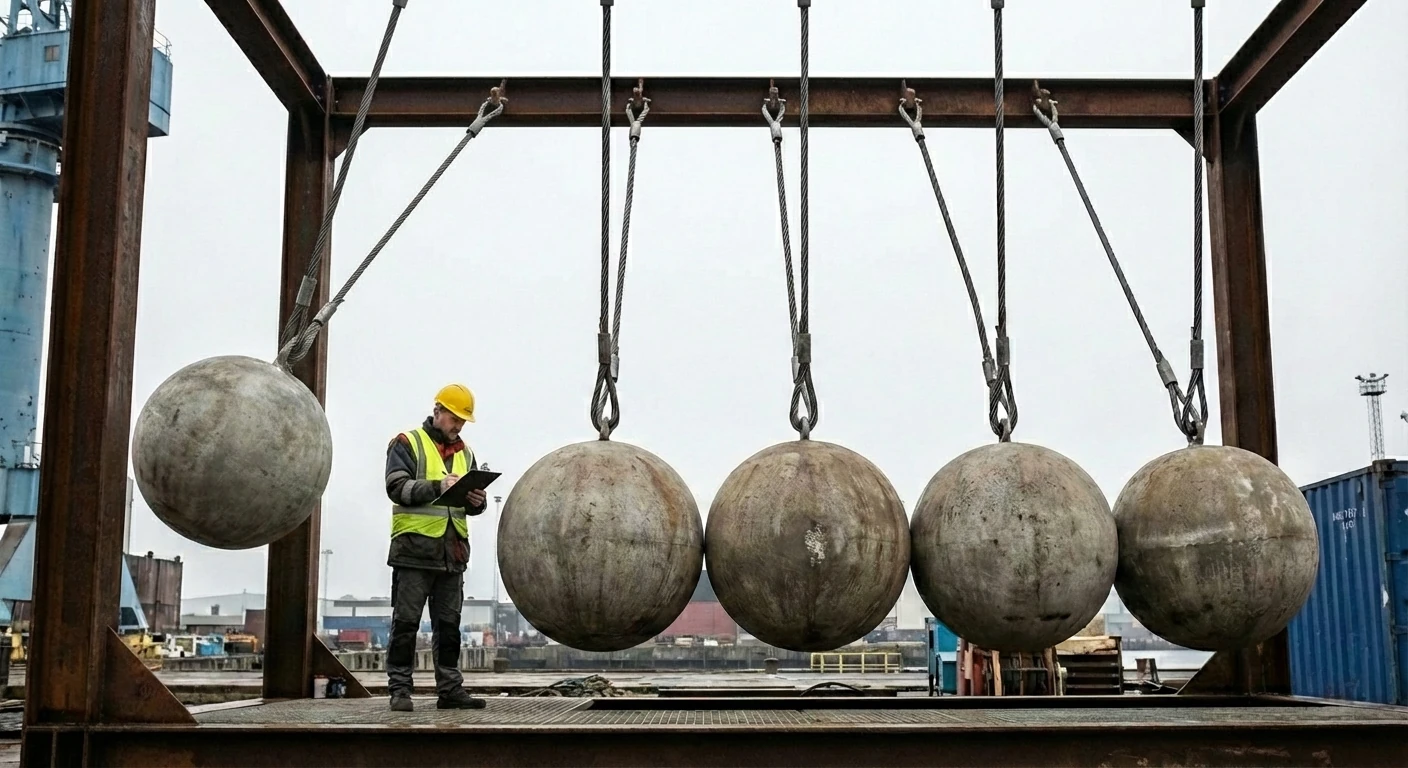
But let's put on our physics glasses for a moment. If that flywheel is scaled up properly that's twice the diameter, assuming same thickness, means four times the mass. And the moment of inertia, which is what stores the spinning energy, it doesn't just double... it goes up by a factor of sixteen. Sixteen! That guard Joe was thinking of? It wouldn't just fail; no, it would be shredded.
This is the kind of miscalculation that happens all the time in heavy industry. Let me give you a few more examples:
The Crate That Became An Elephant
Suppose you're called for advice on moving a crate. You just moved a crate of the same shape yesterday — 40 cm sides, no problem. You ask your colleague on the phone how much bigger today's crate is. Now, he takes out his Stanley tape, measures one of the sides, and reports back on the phone "80 cm sides". Your brain wants to say "About twice as big then, same straps should do it". But if we imagine that the crate is roughly a cube, that's twice as wide, twice as deep, twice as tall. It has eight times the mass. What was a manual handling task just became a crane accident waiting to happen.
The Speed That Squares Itself
Here's one everyone gets wrong. Kinetic energy, the energy of motion, it goes up with the square of the velocity. So a car at 20 km/h doesn't have twice the energy of a car at 10 km/h. It has four times the energy. At 40 km/h, it's sixteen times the energy. This is why those small increases in speed on the highway matter so much more than people think.
Making The Risk Matrix Honest
Now, many organisations use these familiar colourful charts, risk matrices we call them. You multiply "likelihood" by "consequence." The likelihood part, well, that's often a bit of a guess. But the consequence part? That should be a hard fact. But because of this scaling problem, we keep putting things in the wrong boxes.
Take a 2-inch pressurised hose versus a 4-inch one. We think, "They're both high-pressure hoses. Same category." But the force on a fitting in that 4-inch hose? That's four times larger, because area goes up with the square of the diameter. If it fails, you're not just getting "more" of the same accident, but a completely different class of accident. Energy-Based Safety gives you that correction factor. It forces you to look past the word "hose" and look at the actual numbers that matter.
Where This Doesn't Work
Now I have to be very clear here. This energy way of thinking is not a universal key. It doesn't work for everything. Chemical toxicity? A tiny bit of hydrogen sulfide can kill you dead, no matter how slowly it's moving or how low to total burn energy is. Repetitive strain injuries? No amount of energy calculation will tell you about that. Sharp blades? It's not the weight that matters. Biological hazards, psychological safety — forget it. This is a specialised tool, not a Swiss Army knife.
Energy-Based Safety is specifically for trauma prevention. It's for when things can hit you, crush you, or throw you. Think mobile plant, lifting and rigging, pneumatics and hydraulics, tensioned cables: situations where energy gets stored and then, perhaps, released all at once.
So What Do We Actually Do?
You don't need to throw out all your existing procedures or overhaul your software. You just need to add a little question during your planning phase, a sort of sanity check. When you're looking at a Safe Work Procedure or a Lift Plan, don't just ask "Is this dangerous?" First ask: "If I change this variable just a little bit, does the energy change a lot?"
If the answer is yes, and it is for things like RPM, pressure, or suspended mass, then administrative controls like signs or "being careful" are just not good enough. Those are the situations where you need proper physical isolation, rated guards, engineering controls. Because the energy has scaled up beyond what you can "eyeball."
Why Bother?
We need this way of thinking not because it's fashionable, but because we're playing with energy levels that most of human history never had to deal with. Our ancestors worried about falling off cliffs or getting hit by a slow-moving cart. They didn't have silently-spinning flywheels storing enough energy to gut an elephant.
By explicitly thinking about energy, by making that little calculation, or even just asking the question, we replace a flawed intuition with something solid. We make sure our safety controls match the actual magnitude of the danger, not the one our linear brains imagine. And in this business, that little bit of squaring and cubing can make all the difference between a close call and a catastrophe.






Assuming solid disk flywheel, constant thickness and density:
(area ∝ r2 → (2)2 = 4)
I′ = ½ × (4m) × (2r)2 = ½ × 4m × 4r2 = 8 m r2
Result: 4× heavier, but 16 times the stored rotational energy.